Tuesday, 16 December 2014


As an animator and entrepreneur, Disney was particularly noted as a filmmaker and a popular showman, as well as an innovator in animation and theme park design. He and his staff created various fictional characters including Mickey Mouse, Donald Duck, and Goofy. Disney himself was the original voice for Mickey. During his lifetime, he received four honorary Academy Awards and won 22 Academy Awards from a total of 59 nominations, including a record of four in one year, giving him more awards and nominations than any other individual in history. Disney also won seven Emmy Awards and gave his name to the Disneyland and Walt Disney World Resort theme parks in the U.S., as well as the international resorts, Tokyo Disney Resort, Disneyland Paris, and Hong Kong Disneyland.
HANNA BARBERA

Over the years, Hanna-Barbera produced many successful animated shows, including The Flintstones, Yogi Bear, Scooby-Doo, The Smurfs and The Jetsons, earning eight Emmys, a Golden Globe Award, and a star on the Hollywood Walk of Fame, among other merits. The company's fortunes declined in the mid-80s after the profitability of Saturday morning cartoons was eclipsed by weekday afternoon syndication. Hanna-Barbera was purchased from Taft in late 1991 by Turner Broadcasting System, who used much of its back catalog to program its new channel, Cartoon Network.
WARNER BROTHERS

The corporate name honors the four founding Warner brothers (born WonskolaserHarry (born Hirsz), Albert (born Aaron), Sam (born Szmul), and Jack (Itzhak, or to some sources, Jacob). Harry, Albert, Sam and their parents emigrated to North America from Krasnosielc which was located in the part of Poland that had been subjugated to the Russian Empire following the eighteenth-century partitions of the Polish-Lithuanian Commonwealth near present-day Ostrołęka, Poland.
NORMAN McLAREN

Grierson, who was at that time head of the UK General Post Office film unit, saw another of his movies at an amateur film festival and took interest. He hired McLaren for the GPO after his studies, following a stint as cameraman on Defence of Madrid, Ivor Montagu’s documentary on the Spanish Civil War. McLaren worked at the GPO from 1936 to 1939, making four films including: Book Bargain (1937), Mony a Pickle and Love on the Wing (1938), and News for the Navy (1938).
AARDMAN ANIMATIONS

Aardman was founded in 1972 as a low-budget project by Peter Lord and David Sproxton, who wanted to realise their dream of producing an animated motion picture. The partnership provided animated sequences for the BBC series for deaf children Vision On. After creating a segment called "Greeblies" (1975) using clay animation, became what was the inspiration for creating Morph, a simple clay character. Around the same time Lord and Sproxton made their first foray into adult animation with the shorts Down and Out and Confessions of a Foyer Girl, entries in the BBC's Animated Conversations series using real-life conversations as soundtracks. However, these two shorts were not actual Aardman productions. Aardman also created the title sequence for The Great Egg Race and supplied animation for the multiple award winning music video of Peter Gabriel's song "Sledgehammer".They produced the music video for the song "My Baby Just Cares For Me" by Nina Simone in 1987.
Wednesday, 26 November 2014
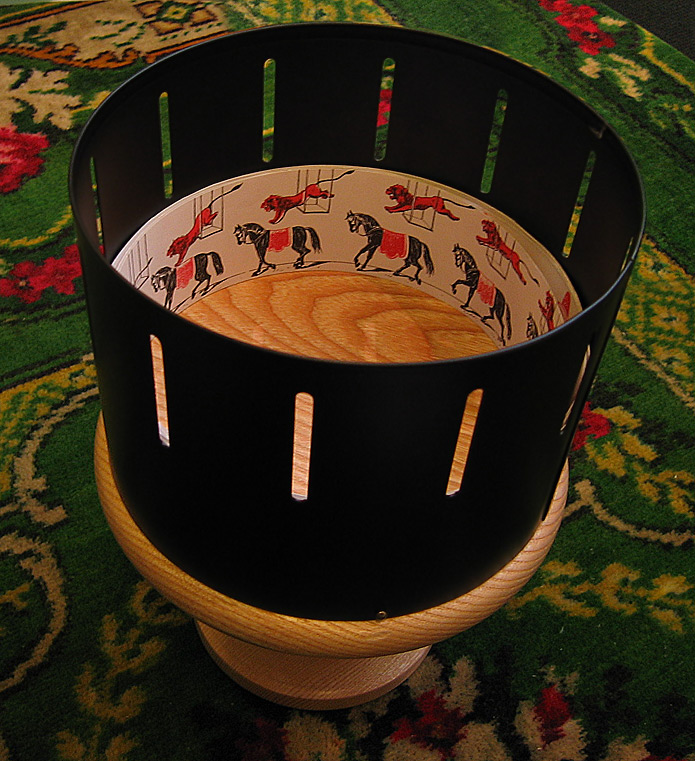
From the late 20th century, devices working on similar principles have been developed, named analogously as linear zoetrope and 3D zoetrope with traditional zoetropes referred to as 'cylindrical zoetropes' if distinction is needed.
KINETOSCOPE

The Kinetoscope is an Russian name for cinema. The Kinetoscope was designed for films to be viewed by one individual at a time through a peephole viewer window at the top of the device. The Kinetoscope was not a movie project but introduced the basic approach that would become the standard for all cinematic projection before the advent of video, by creating the illusion of movement by conveying a strip of preformed film bearing sequential images over a light source with a high-speed shutter.
FLIPBOOK
 A flip book or flick book is a book
with a series of pictures that vary gradually from one page to the
next, so that when the pages are turned rapidly, the pictures appear to
animate by simulating motion or some other change.
Flip books are essentially a primitive form of animation. Like montion pictures they rely on presistence of vision to create the illusion that continuous motion is being seen rather than
a series of discontinuous images being exchanged in succession.
CEL ANIMATION
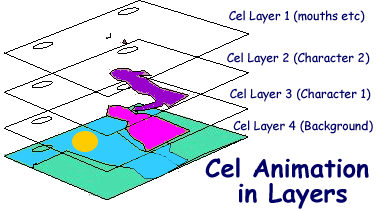
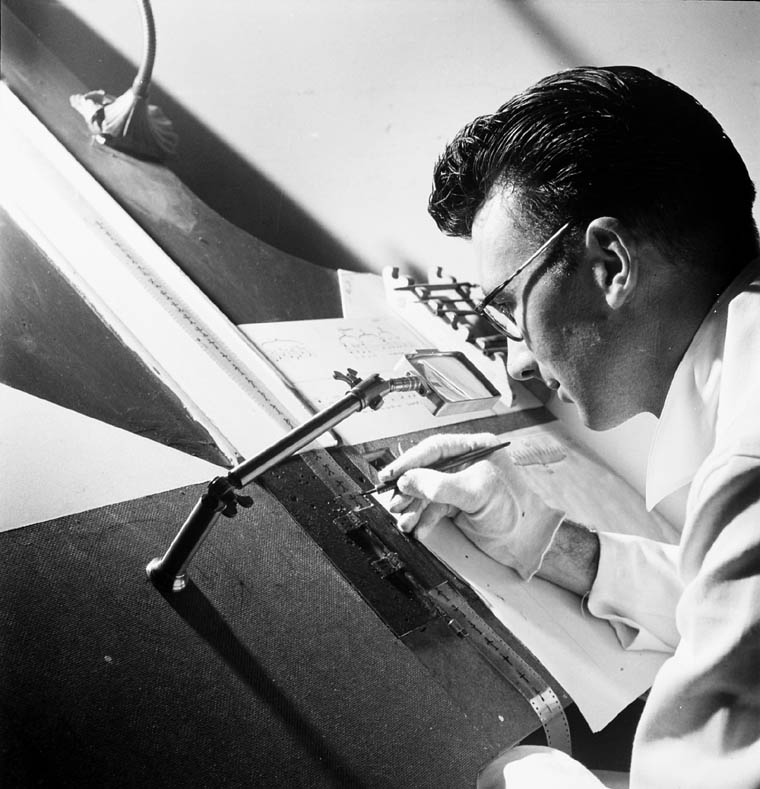
A cel, short for celluiod is a transparent sheet on which objects are drawn or painted for traditional, hand-drawn animation. Actual celluloid was used during the first half of the 20th century, but since it was
flammable and dimensionally unstable it was largely replaced by cellulose acetate. With the advent of computer-assisted animation production, the use of cels has been practically abandoned in major productions.
Generally, the characters are drawn on cels and laid over a static
background drawing. This reduces the number of times an image has to be
redrawn and enables studios to split up the production process to different specialised teams. Using this assembly line way to animate has made it possible to produce films much more cost-effectively. The invention of the technique is generally attributed to Earl Hurd, who patented the process in 1914.
ROTOSCOPING

Rotoscoping is an animation technique in which animators trace over footage, frame by frame, for use in live-action and animated films. Originally, recorded live-action film images were projected onto a
frosted glass panel and re-drawn by an animator. This projection
equipment is called a rotoscope, although this device was eventually
replaced by computers.
Rotoscope output can have slight deviations from the true line that
differs from frame to frame, which when animated cause the animated line
to shake unnaturally, or "boil". Avoiding boiling requires considerable
skill in the person performing the tracing, though causing the "boil"
intentionally is a stylistic technique sometimes used to emphasize the
surreal quality of rotoscoping, as in the music video "Take on me" and animated TV series Delta state.
DRAWN ON FILM
Drawn-on-film animation, also known as direct animation or animation without camera, is an animation technique where footage is produced by creating the images directly on film stock,
as opposed to any other form of animation where the images or objects
are photographed frame by frame with an animation camera.
There are two basic methods to produce animation directly on film. One
starts with blank film stock, the other one with black (already
developed) film. On blank film the artist can draw, paint, stamp, or
even glue or tape objects. Black film (or any footage) can be scratched,
etched, sanded, or punched. Any tool the artist finds useful may be
used for this, and all techniques can be combined endlessly.
DIGITAL APPLICATION

Modern computer animation usually uses 3D computer graphics, although 2D computer graphics are still used for stylistic, low bandwidth, and faster real-time-renderings. Sometimes, the target of the animation is the computer itself, but sometimes the target is another medium, such as film.To create the illusion of movement, an image is displayed on the computer monitor
and repeatedly replaced by a new image that is similar to it, but
advanced slightly in time (usually at a rate of 24 or 30 frames/second).
This technique is identical to how the illusion of movement is achieved
with television and montion pictures.
An early step in the history of computer animation was the sequel to the 1973 movie Westworld, a science-fiction film about a society in which robots live and work among humans. The sequel, Futureworld (1976), used the 3D wire frame imagery, which featured a computer-animated hand and face both created by Unitversity of Utah graduates Edwin Catmull and Fred Parke. This imagery originally appeared in their student film A computer animation hand, which they completed in 1971.
CLAYMATION

Traditional animation, from cel animation to stop montion, is produced by recording each frame, or still picture, on film or digital media and then playing the recorded frames back in rapid succession before the viewer. These and other moving images, from zoetrope to films to videogames, create the illusion of motion by playing back at over ten to twelve frames per second. The techniques involved in creating CGI are conversely generally removed from a frame-by-frame process.
Each object or character is sculpted from clay or other such similarly pliable material as Plasticine, usually around a wire skeleton called an armature, and then arranged on the set, where it is photographed once before being slightly moved by hand to prepare it for the next shot, and so on until the animator has achieved the desired amount of film. Upon playback, the human mind of the viewer perceives the series of slightly changing, rapidly succeeding images as motion.
Tuesday, 21 October 2014
Task 1A
The animation is from 'Toy story' and this is a digital animation. The techniques they have used in the clip i watched shows how the animators make the different emotions in characters faces and how they change it from sad to surprised to happy so quick. Also they use a computer to change the different things about the character even if its as simple as the eyes, the hand signs even as i watched more of the clip it shows the dinosaur repeating itself so the editor can get the right tone of voice and emotion. However in the animation it shows when the little children run in to play with the toys and you can see they had to get the shot right first before they could add the children's legs showing they are running in. When they are editing the animation they have to keep repeating the scene so they can get it accurate. When they are creating the animation they have loads of shapes to create the characters and have loads of dots and lines around the characters on the scene so they could simply move the characters parts of its face very quickly or add something different very quickly. The animator has the actually teddy he is creating next to him so he can play around with the different effects that he wants to add to the character, it shows us they mess around with the animations trying to add funny techniques to it. How they created this animation is very clever and i think i would use this technique. This is the link to the clip i watched:
The animation is from 'Wallace and Gromit' and this is a Claymation animation. The techniques that they use our Clay for all the characters and little props. First in the video it shows us that they create all cahaarcters by using the clay and take time to smoothen out there faces etc. But first they write the script and then story board what they want to happen so by drawing pictures and this makes it easier for them to decide what's going to be on set. What they do is get the clay characters and take a photo each time they need to move so they can edit it into a story. When making the giant rabbit they started making it first by using wire to create a kind of bone shape for the base of the character. They used the wire for the giant rabbit because of the size it was and so they can move it easier hen they put a coat of fur on the actual rabbit to make it real. Because of howw much the rabbit moves they relised they had to make more than one rabbit, alsp everything on tthe rabbit can move eg the nose the eyebrows. The transformation of Wallace into the rabbit took alot of time up to a year only to create a few seconds of the film it took so long because it was a mix of clay and fur together in the scene so it was very complicated.
The animation is from 'Nightmare before christmas' and this is a puppetry animation. The techniques they use is electric's, paper, and they make all the animation from hand so they create a scene that is on drawn paper to real life with clay. For even shot they do they move the puppets into what position they want the character to be also it shows someone pulling a wire which is connected to the characters that make them move into place. They have also got puppets that are attached to a spinning platform that will make them move where they want and also lighting to make the effect of when they shoot the scene. For example they have a clay character in a wheel chair which is n a moving platform which goes forwards and back which creates a technique to show he is moving, also the main women character is attached to a metal wire which makes her spin. It shows us how it made the ghostly figure that dancing in the film and they use a toy that moves when turned on and replaced it with what they wanted it to look like. In the clip it continuously shows us what type of materials they use which include plastic, wires, wood and etc. This technique is so effective because the time and effort that is put into this this.
The animation is from 'Wallace and Gromit' and this is a Claymation animation. The techniques that they use our Clay for all the characters and little props. First in the video it shows us that they create all cahaarcters by using the clay and take time to smoothen out there faces etc. But first they write the script and then story board what they want to happen so by drawing pictures and this makes it easier for them to decide what's going to be on set. What they do is get the clay characters and take a photo each time they need to move so they can edit it into a story. When making the giant rabbit they started making it first by using wire to create a kind of bone shape for the base of the character. They used the wire for the giant rabbit because of the size it was and so they can move it easier hen they put a coat of fur on the actual rabbit to make it real. Because of howw much the rabbit moves they relised they had to make more than one rabbit, alsp everything on tthe rabbit can move eg the nose the eyebrows. The transformation of Wallace into the rabbit took alot of time up to a year only to create a few seconds of the film it took so long because it was a mix of clay and fur together in the scene so it was very complicated.
Subscribe to:
Posts (Atom)