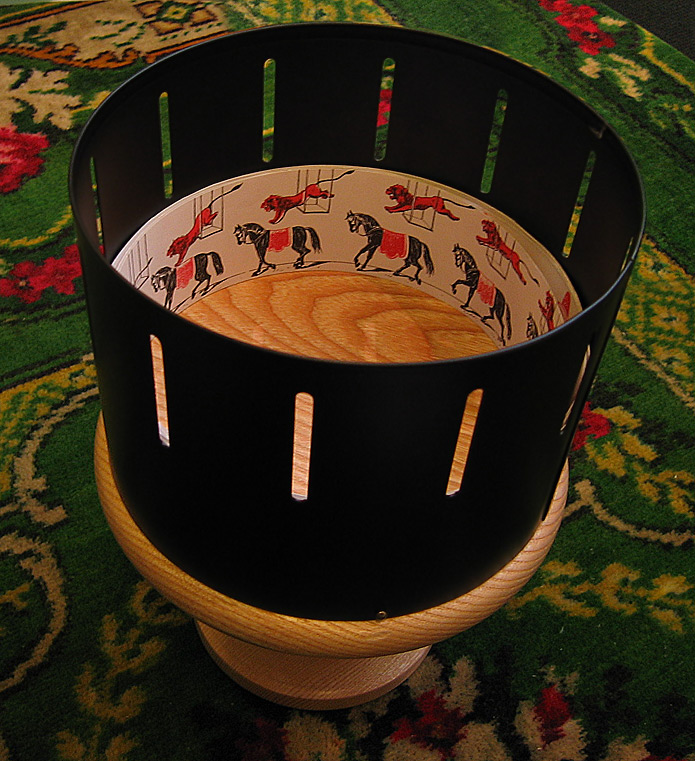
From the late 20th century, devices working on similar principles have been developed, named analogously as linear zoetrope and 3D zoetrope with traditional zoetropes referred to as 'cylindrical zoetropes' if distinction is needed.
KINETOSCOPE

The Kinetoscope is an Russian name for cinema. The Kinetoscope was designed for films to be viewed by one individual at a time through a peephole viewer window at the top of the device. The Kinetoscope was not a movie project but introduced the basic approach that would become the standard for all cinematic projection before the advent of video, by creating the illusion of movement by conveying a strip of preformed film bearing sequential images over a light source with a high-speed shutter.
FLIPBOOK
 A flip book or flick book is a book
with a series of pictures that vary gradually from one page to the
next, so that when the pages are turned rapidly, the pictures appear to
animate by simulating motion or some other change.
Flip books are essentially a primitive form of animation. Like montion pictures they rely on presistence of vision to create the illusion that continuous motion is being seen rather than
a series of discontinuous images being exchanged in succession.
CEL ANIMATION
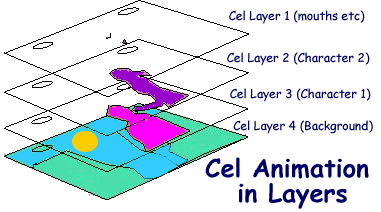
A cel, short for celluiod is a transparent sheet on which objects are drawn or painted for traditional, hand-drawn animation. Actual celluloid was used during the first half of the 20th century, but since it was
flammable and dimensionally unstable it was largely replaced by cellulose acetate. With the advent of computer-assisted animation production, the use of cels has been practically abandoned in major productions.
Generally, the characters are drawn on cels and laid over a static
background drawing. This reduces the number of times an image has to be
redrawn and enables studios to split up the production process to different specialised teams. Using this assembly line way to animate has made it possible to produce films much more cost-effectively. The invention of the technique is generally attributed to Earl Hurd, who patented the process in 1914.
ROTOSCOPING

Rotoscoping is an animation technique in which animators trace over footage, frame by frame, for use in live-action and animated films. Originally, recorded live-action film images were projected onto a
frosted glass panel and re-drawn by an animator. This projection
equipment is called a rotoscope, although this device was eventually
replaced by computers.
Rotoscope output can have slight deviations from the true line that
differs from frame to frame, which when animated cause the animated line
to shake unnaturally, or "boil". Avoiding boiling requires considerable
skill in the person performing the tracing, though causing the "boil"
intentionally is a stylistic technique sometimes used to emphasize the
surreal quality of rotoscoping, as in the music video "Take on me" and animated TV series Delta state.
DRAWN ON FILM
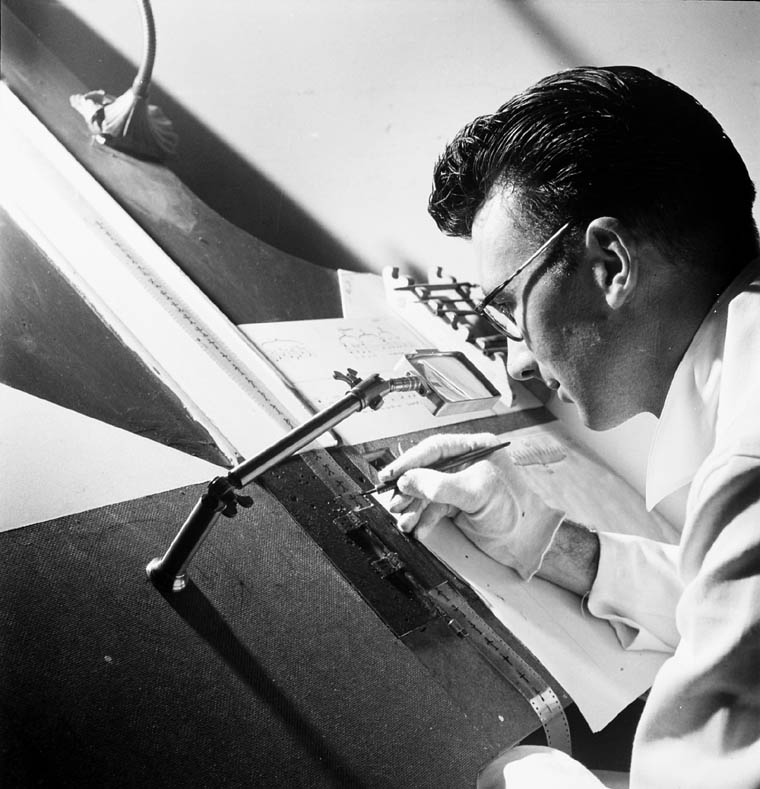
Drawn-on-film animation, also known as direct animation or animation without camera, is an animation technique where footage is produced by creating the images directly on film stock,
as opposed to any other form of animation where the images or objects
are photographed frame by frame with an animation camera.
There are two basic methods to produce animation directly on film. One
starts with blank film stock, the other one with black (already
developed) film. On blank film the artist can draw, paint, stamp, or
even glue or tape objects. Black film (or any footage) can be scratched,
etched, sanded, or punched. Any tool the artist finds useful may be
used for this, and all techniques can be combined endlessly.
DIGITAL APPLICATION

Modern computer animation usually uses 3D computer graphics, although 2D computer graphics are still used for stylistic, low bandwidth, and faster real-time-renderings. Sometimes, the target of the animation is the computer itself, but sometimes the target is another medium, such as film.To create the illusion of movement, an image is displayed on the computer monitor
and repeatedly replaced by a new image that is similar to it, but
advanced slightly in time (usually at a rate of 24 or 30 frames/second).
This technique is identical to how the illusion of movement is achieved
with television and montion pictures.
An early step in the history of computer animation was the sequel to the 1973 movie Westworld, a science-fiction film about a society in which robots live and work among humans. The sequel, Futureworld (1976), used the 3D wire frame imagery, which featured a computer-animated hand and face both created by Unitversity of Utah graduates Edwin Catmull and Fred Parke. This imagery originally appeared in their student film A computer animation hand, which they completed in 1971.
CLAYMATION

Traditional animation, from cel animation to stop montion, is produced by recording each frame, or still picture, on film or digital media and then playing the recorded frames back in rapid succession before the viewer. These and other moving images, from zoetrope to films to videogames, create the illusion of motion by playing back at over ten to twelve frames per second. The techniques involved in creating CGI are conversely generally removed from a frame-by-frame process.
Each object or character is sculpted from clay or other such similarly pliable material as Plasticine, usually around a wire skeleton called an armature, and then arranged on the set, where it is photographed once before being slightly moved by hand to prepare it for the next shot, and so on until the animator has achieved the desired amount of film. Upon playback, the human mind of the viewer perceives the series of slightly changing, rapidly succeeding images as motion.

No comments:
Post a Comment